

Trump announces lower drug prices in deals with nine companies

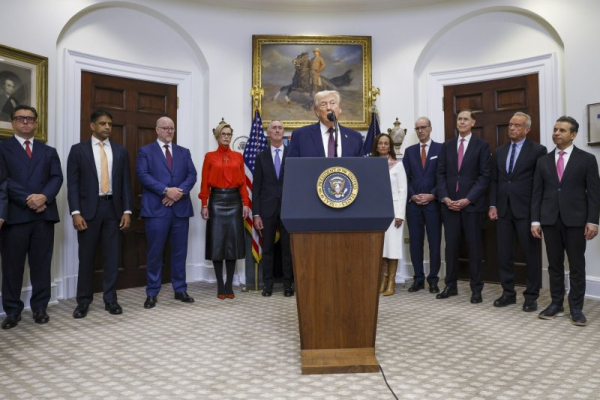
1 of 3 | President Donald Trump appears with pharmaceutical executives, in describing lowering the prices of drugs and pharmaceuticals during an announcement in the Roosevelt Room of the White House on Feriday. Photo by Will Oliver/UPI | License Photo
President Donald Trump on Friday announced that nine of the largest drugmakers in the United States and Europe have agreed to voluntarily sell their medications at lower prices in a “Most Favored Nation” program.
In return, the companies won’t have tariffs placed on their products during a three-year grace period if they collectively invest at least $150 billion in U.S. manufacturing.
All state Medicaid programs will have access to lower drug prices on products, “resulting in billions of dollars in savings and continuing President Trump’s historic efforts to strengthen the program for the most vulnerable,” according to a White House fact sheet.
Most people get drugs through Medicare, employers’ group insurance and the Affordable Care Act, known as Obamacare, on the marketplace exchange. The Obamacare enhanced tax credits expire at the end of the year.
Trump said he will call a meeting next week or early January with health insurers to push them to lower their premiums, though costs from providers, including doctors and hospitals, have been soaring.
“I’m going to call in the insurance companies that are making so much money, and they have to make less – a lot less,” said Trump, adding he wants the federal government to give money directly to Americans to purchase coverage, instead of subsidizing insurers. “Maybe we can have reasonable healthcare without having to cut them out.”
He praised drug companies for doing their part to lower health costs during an appearance with them in the White House’s Roosevelt Room.
“This is affordability in action,” Dr. Mehmet Oz, Centers for Medicare and Medicaid Services administrator, said at the event.
The costly drugs treat chronic conditions, including Type 2 diabetes, rheumatoid arthritis, multiple sclerosis, asthma, chronic obstructive pulmonary disease, hepatitis B and C, human immunodeficiency virus (HIV), and certain cancers.
For example, Bristol Myers Squibb will offer Eliquis, a top-prescribed blood thinner for free to U.S.-run Medicaid, CNBC reported. The HIV medication, Reyataz, will drop from $1,449 to $217 for patients purchasing directly through TrumpRx.
The other companies are: Merck, Amgen, Gilead, GSK, Sanofi, Roche’s Genentech, Boehringer Ingelheim and Novartis. They are all public companies except Boehringer Ingelheim.
They are among 17 drug companies Trump sent letters in July, calling on them to lower prices for his “most favored nation” policy.
Johnson & Johnson, AbbVie and Regeneron haven’t announced drug deals yet but Trump noted that Johnson & Johnson “will be here next week.”
Companies that earlier reached deals were Pfizer, AstraZeneca, Eli Lilly, Novo Nordisk and EMD Serono. Serono.
In May, he signed an executive order seeking to “end global freeloading.”
In the U.S., prescription drugs are nearly three times more expensive than overseas, according to a 2024 study by RAND Corporation. Branded drugs were more than four times higher, according to the report.
“As of today, 14 out of the 17 largest pharmaceutical companies … have now agreed to drastically lower drug prices for … the American people and the American patients,” Trump said at the event. “This represents the greatest victory for patient affordability in the history of American healthcare, by far, and every single American will benefit.”
Manufacturers agreed to offer medications directly to consumers via TrumpRx.gov, expected to be operational in early 2026.
And some companies have launched or plan to debut direct-to-consumer options for some drugs.
As part of the agreement, several companies are “donating active pharmaceutical ingredients for key products to the Strategic Active Pharmaceutical Ingredients Reserve to reduce reliance on foreign nations and ensure the United States has an adequate supply of such products in the event of an emergency.”
Price reductions
The White House laid out several examples of price reductions if they are bought through TrumpRX or the companies’ own direct-to-consumer programs.
Gilead said it will allow patients to access its Hepatitis C treatment and cure, Epclusa, at a discounted price of $2,425 from $24,920.
Sanofi plans to offer discounts on nearly 70% of medications to treat infections and cardiovascular and diabetic conditions. For example, the prescription blood thinner, Plavix, will go from $756 to $16. Sanofi will list insulin products at TrumpRx at $35 per month’s supply.
Merck will provide three diabetes drugs — Januvia, Janumet and Janumet RX — about a 70% discount in a direct-to-patient program. Januvia will go from $330 to $100 for patients.
And they will offer the company’s experimental daily cholesterol pill once it is approved by the Food and Drug Administration.
“I reflect on your goal of driving affordability and access to Americans, but equally, getting prices up outside the United States,” Merck CEO Robert Davis said during the news conference. “And we’re 100% supportive of your actions.”
Amgen plans to expand its direct-to-patient program with preventive migraine medication Aimovig at a 60% reduction and autoimmune treatment Amjevita at 60%.
GSK will reduce the popular asthma inhaler Advair Diskus 500/50 for $89 from $265.
Boehringer Ingelheim’s Type 2 diabetes medication, Jentadeuto, will go from $525 to $55.
Genentech will cut the price of its flu medication, Xofluza, from $168 to $50.
Novartis’ Multiple Sclerosis medication, Mayzent, will fall from $9,987 to $1,137 .
Skepticism about the program
The vast majority of Americans will find it less expensive to go through their insurance, Chris Meekins, managing director of health policy research at Raymond James, told CNN.
Drugmakers know these deals are “largely inconsequential” to their profit margins, he said.
And GLP-1 drugs, such as Novo Nordisk’s Wegovy and Eli Lilly’s Zepbound, aren’t covered as they aren’t widely covered by insurers for weight loss. Eli Lilly and Novo Nordisk are already offering their medications at steep discounts through their own direct-to-consumer portals.
Trade association PhRMA, which represents many major pharma companies, opposes the change, saying most-favored nation pricing isn’t the best way to lower drug costs for Americans. They blamed pharmacy benefit managers for the price disparity.
“Proposals like most favored nation price controls and tariffs will undermine American leadership of the biopharmaceutical industry and limit treatment availability for patients,” PhRMA said. “The tradeoff that’s been made for the past decade is a lower percentage on medicines, and we’re reaping the consequences of that now in a very urgent way. Meanwhile, middlemen and others here at home pocket half of every dollar spent on brand medicines. These imbalances drive up costs for everyone.”
PhRMA said member companies are delivering $500 billion in new U.S.-based manufacturing and infrastructure investment.
“The biopharmaceutical industry is stepping up with new innovative cures, infrastructure investments, new jobs, as well as patient resources,” PhRMA said. “However, to reduce price differentials with other wealthy countries, we should require PBMs [private benefit managers] to share savings directly with patients and reform misaligned incentives, fix the $340 billion hospital markup program, and force foreign governments to pay their fair share for cutting-edge innovation.”